

How To Use Lego Power Functions Motor Set
- The new version of the RC Receiver supports all functionality of the LPF RC protocol including �single pin mode�.
- The production lawmaking is the aforementioned #8884 � the new detail number is 4566735.
- Orders through LEGO shop online for #8884 will provide the new version.
 Ability Functions� presentation
Article written in collaboration with Didier Enjary
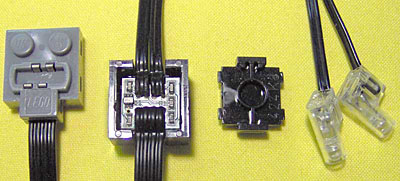
February 2009 update: Richard Forster-Pearson sent me schematics and photos of the Power Functions lights.
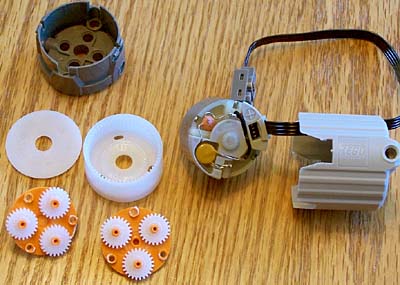
July 2008 update: Brian Davis opened a XL motor, his photos details the dual stage planetary gear reduction .
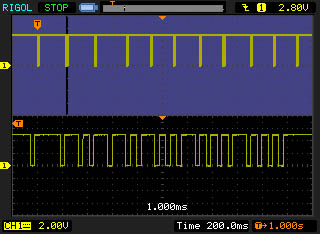
June 2022 update: Victor Sluiter made measurements Power Functions protocol, his findings are here.
He is also building a small form cistron IR receiver .
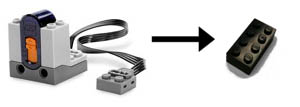
| January 2008: LEGO release the infra-carmine protocol used by Power Functions Here is the notice accompanying the document: Last yr we introduced a range of products using our new electronic edifice arrangement: LEGO Ability Functions. This new electronic edifice system will open up a lot of possibilities now and in the time to come. One of the new things we offer now is modular remote control. In the process of designing the Power Functions RC system we did a mapping of unlike RC functionalities. This mapping formed the basis of the Power Functions RC protocol and most of this is built into the Power Functions RC Receiver. The RC Handset launched now provides direct 'bang-bang' control, but the RC Receiver supports much more functionality similar PWM speed control and single pin performance. At present that the Ability Functions elements are bachelor at the LEGO Shop online we take decided to release the Ability Functions RC protocol as open source. Delight feel free to apply whatsoever information from the protocol certificate for personal, non-commercial use only, provided you proceed intact copyright, trademarks and other proprietary rights of the LEGO Company - have fun. Gaute Munch, Engineering science Product Manager, LEGO Company |
| Oct 2009: LEGO release update 1.i of the infra-scarlet protocol used by Power Functions Here is the discover accompanying the document: The LEGO Grouping has released a new version of the LEGO Power Functions RC Receiver (identified past a short blink on the green LED when power is connected). The new version of the RC Receiver supports all functionality of the LPF RC protocol and we take added a control to admission the extra address infinite. We are hereby offering y'all an updated version of the LPF RC protocol documentation. Please feel gratis to use any data from the protocol document for personal, not-commercial use only, provided you continue intact copyright, trademarks and other proprietary rights of the LEGO Group. Gaute Munch, The LEGO Group Additional notes: |
| March 2010: LEGO release update i.two of the infra-red protocol used by Power Functions |
| LEGO Ability Functions RC Version i.2 (PDF, 370kb) For reference purpose, previous 1.0 version (PDF, 400kb) and previous i.1 version (PDF, 340kb) |
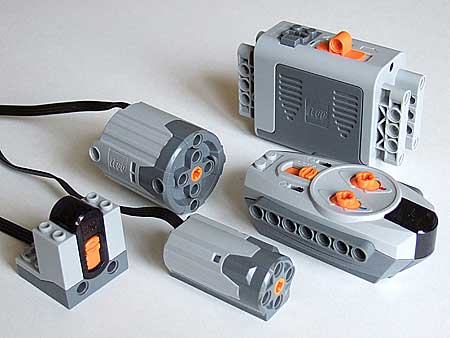
| Power Functions is the new electric edifice organisation by the LEGO company released in 2007 in TECHNIC and Creator sets. The Power Functions family unit is composed of remote control (RC) elements, motors and a make new type of electrical plug and wire. Allow us introduce the family members. | |
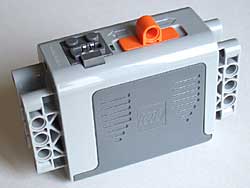
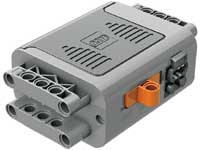
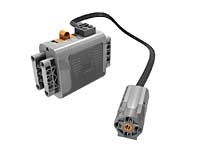
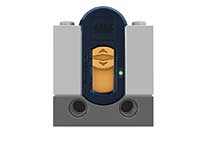
| | The battery box powers the system. A green light betoken that the power is on. The orange control switch can be pushed in either side driving a motor in either management. In the middle position power is turned off. The plug is of female type and in the whole system, female plugs are the feeding plugs just similar the domestic Ac plugs are. The bombardment box needs to exist filled with 6 AA-size batteries. |
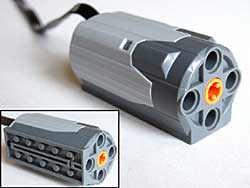
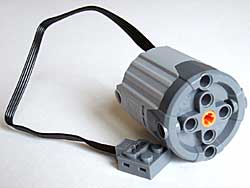
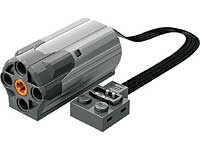
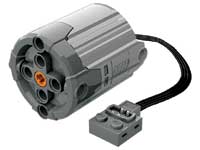
| The motors are internally highly geared down, turning slowly and delivering high torque. See the technical measurements in the 2nd part of this presentation, and in the 9V motors comparison folio. They receive power through an fastened cable. In that location are two types of motors : a medium one and an XL 1. | |
| | The medium motor fits both studded and studless elements as shown in the analogy. It is 6L long and 3L wide and alpine. |
| | The 40 motor is studless only and its diameter is 5L wide. |
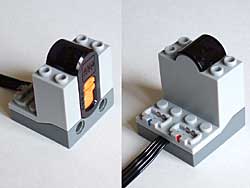
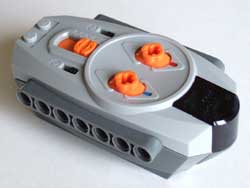
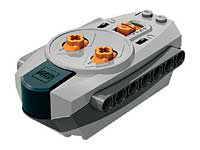
| The RC handset and receiver work together, the handset sending IR signals to the receiver. The RC system has 4 channels and you lot will find channel selectors on both the remote and receiver. | |
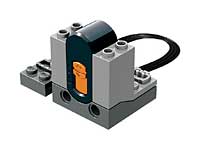
| | The receiver has two outputs, red and blue coded, corresponding to the 2 control buttons on the handset. This way you tin independently command up to 8 dissimilar functions in your models. Just like the motors, the receiver is powered through a cable. Every bit the bombardment box, the outputs plugs are of the female type. |
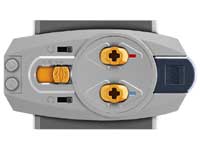
| | The RC handset besides include 2 small black direction switches on each side of the channel selector, below each control buttons. They allow you to flip the direction of the corresponding output. The handset has to exist filled with 3 AAA-size batteries. |
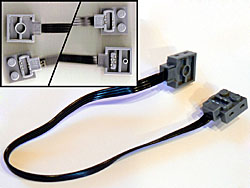
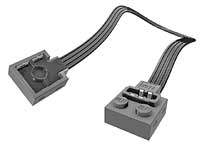
| | The Power Functions plug is of a new type. It has 4 connections giving new possibilities for the future. An extension wire (available early 2008) gives to Power Functions compatibility with the existing 9V electric system and with NXT. |
Power Functions LDraw and LeoCAD parts
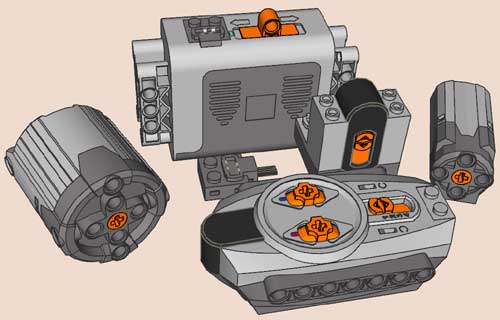
I have modelled all 2007 Power Functions devices. Files necessary to model your constructions are available as LDraw official parts.

Power Functions gallery
Images courtesy of The LEGO Company.
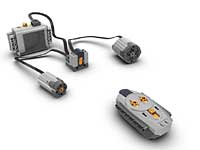
Ability Functions working
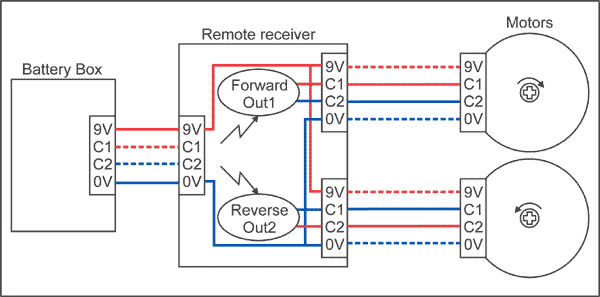
Note: in the above diagram, dotted lines are existing, but unused wires.
.
| | The backbone of PF is a 4-wire cable concluded by a new stackable connector. This connector is keyed so it is always plugged the right way.
Power lines carry supply voltage from the battery box to all devices that need it, such as the remote control receiver. Control signals may be outputs (the remote receiver creates C1/C2 co-ordinate to IR commands) or inputs (the motor takes ability from C1/C2 and turns according to their state). |
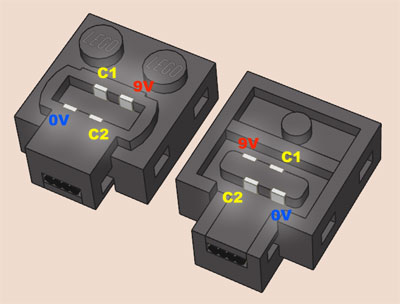
The table and diagram below show the how the arrangement works.
| IR command | Remote control outputs | Motor | |
| C1 | C2 | ||
| Frontward | +9V | 0V | Turns CW |
| Contrary | 0V | 9V | Turns CCW |
| Cease | 0V | 0V | Restriction |
- Normal motors (Medium, Large and XL) as well as Ability Functions light are connected only to C1/C2 lines. These lines carry electrical power needed to make them turn or polish.
- Power Functions servo motor gets its ability from 0/9V lines, and is controlled from the country and PWM duty bike of C1/C2 lines
- All devices that have input and output plug pass through power lines, devices can exist daisy chained. 0 and 9V are bachelor to all element in the chain if they demand them.
- The IR receiver gets it power from 0/9V lines, and according to commands received, delivers power to C1/C2 lines of its ii outputs.
- The Ability Functions battery packs provide power to the PF organisation. 0/9V lines are powered every bit soon as the battery pack is on, with stock-still polarity. C1/C2 lines are likewise powered, allowing a direct connectedness of a motor to the battery pack. Their polarity (hence motor rotation direction) depends on the management of the switch of the battery pack. In addition, the rechargeable battery pack has a variable speed control, and provides C1/C2 with pulse width modulated power.
A few facts and tips:
Power Functions motors compared to old 9V motor
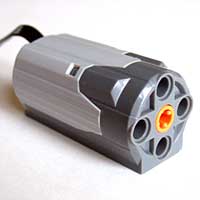
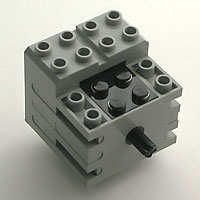
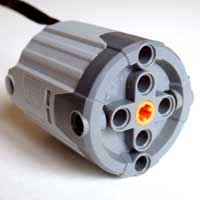
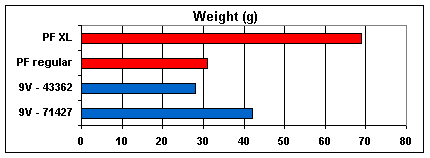
We compare here PF motors simply with regular 9V mini-motor in its two versions: the 71427 produced from 1997 to 2002 and the 43362 motor produced from 2002 to 2006. Externally identical these motors differ mainly in the weight, 43362 motor is much lighter.
All the tests below are performed with motors directly continued to a laboratory power supply.
| | PF regular has a weight comparable to 9V motors. XL is much more than heavy, something to look from such a powerful thing. |
| | Volume of the bounding box of the motor |
| | PF XL turns slowly, giving it an impressive torque. One time again, PF regular is similar to 9V motors. |
| | A weak indicate of PF motors: their no-load current is loftier, denoting internal friction. They are non well suited to low power applications such as solar panel supply. 71427 was exceptionally good for that. |
| | Maximum torque delivered by the motors (motor is blocked). PF regular provides twice the torque of 9V motors, while PF XL outdoes its rivals with an beam twisting torque! |
| | High torque comes with a price, electric current consumption. Note that the high stalled electric current of Forty motor exceeds maximum electric current delivered by the PF remote receiver (800mA) and of its own internal protection. Maximum torque is simply obtained with direct battery connection for a short time. |
| | Maximum mechanical power is delivered when load halves its no-load rotation speed. PF motors easily outdo their elders here� |
| | �but with a reduced efficiency. Efficiency is the ratio between delivered mechanical ability and electric power provided. Note that the best efficiency is obtained when load decreases rotation speed past i/4 |
| | Ratio of mechanical power by motor weight. |
| | Ratio of mechanical power past motor volume. |
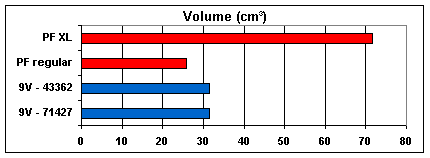
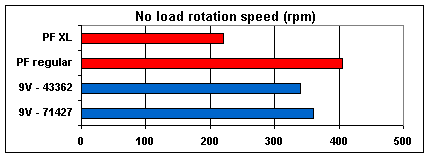
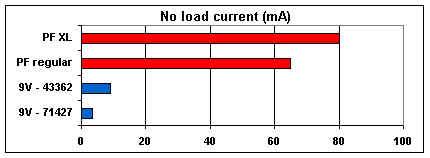
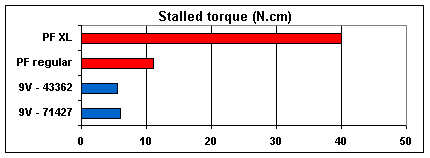
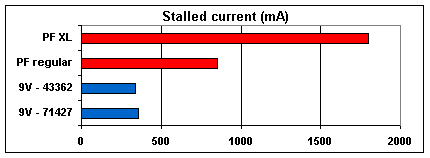
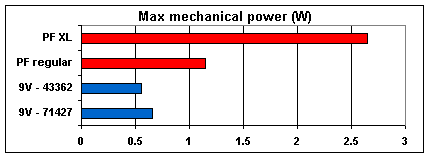
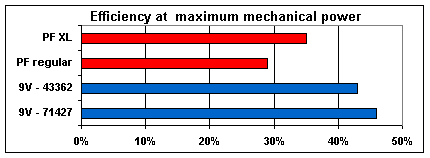
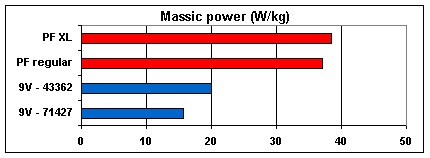
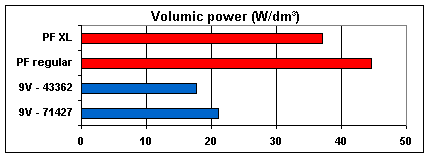
Conclusions are clear: PF motors outperform their elders (sometimes with huge divergence) in all respects except energy efficiency.
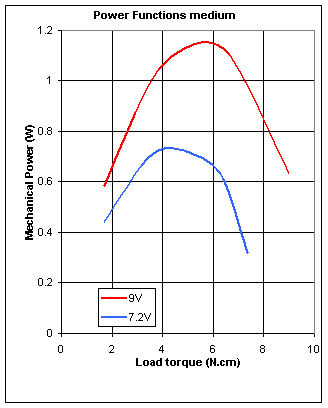
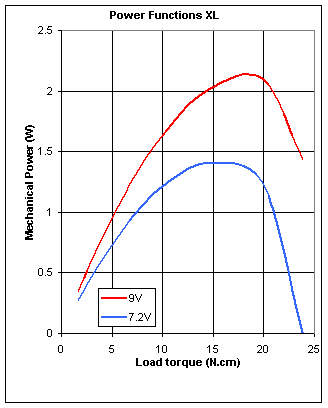
PF motors power curves when connected to IR remote receiver
Since motor driver within remote receiver has some dropout and current limitation, charts to a higher place don�t tell the whole story. The two curves beneath testify the mechanical ability of PF motors driven past the remote receiver. These characteristics were measured at 9V (element of group i batteries voltage) and 7.2V (NiMH rechargeable batteries voltage).
More power curves (with other motors and pairs of motors) are available here.

How To Use Lego Power Functions Motor Set,
Source: https://www.philohome.com/pf/pf.htm
Posted by: eppersonyebere.blogspot.com
0 Response to "How To Use Lego Power Functions Motor Set"
Post a Comment